









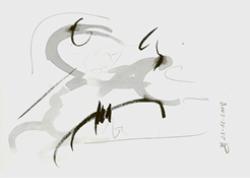

Ausschnitt “mémoiren eines echonebels” (in Arbeit)

Ausschnitt “mémoiren eines echonebels” (in Arbeit)
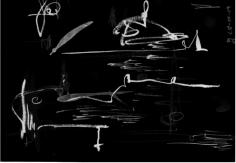

The "foliants" are an extension of „graphic notation“ as developed in the 1950s
(exemplary instances in the work of Earle Brown, Sylvano Bussotti, Cornelius Cardew):
an extension into three dimensions, with a far wider use of colour and a variant use of
shiftable transparent materials (introduced by John Cage in „Variations I“ in 1958).
The three-dimensionality and the shifting are crucial. The former because it enables
these works to exist in principle indepently of any recieved notion of musical notation
(marks and images on a flat surface which can be graphed by vertical and horizontal
coordinates). The latter because it allows a sculptural notion of mobile to be applied to
musical tranformation (in the aspect of notation).
Present and independent as these works may be as visual and sculptural objects, their
imagery includes much that is musical, incorporating parts of musical instruments,
verbally identified by the names of specific instruments and including sometimes
elements of actual musical notation.
They are evocative and elegant representations of musical material. And they are also
intended for musical use, that is to produce music.
As such they raise interesting questions about the relation of notation to musical
performance. For example, how is depth-of-field (the added dimesion) translatable into
musical terms? Literally (say, location in space of sound sources) or figuratively (say, a
variable density of sound)? Or, what is the relation of the time-bound, linear existence
of sound to space? In what sense does a visually defined formal structure determine an
acoustically defined structure?
If musically fine work might be notates in a graphically ugly way, what musical function
might a visually suggestive and beautiful notation have? What is the relation of the
notational object’s permanence and the music’s evanescence? Can the musical
implication (say, the mobility and fragility of movement in time) of these artifacts endow
them with something like a musical soul, as it were, un-freeze, de-reify them?
Notation began as a recording after the fact of musical practice, as a didactic and
memnonic instrument, and it has served as a marker and creator of (a certain kind of)
history. The foliants are, paradoxically, notation as anticipation and at the same time
inducement to a musical practice somewhat released from history.
Christian Wolff

Contemporary innovative art does not usually fail because it is rejected by the
recipient for rejection is due to delayed acceptance, to the phenomenon of
temporary non-comprehension. Rather this failure is due to the fact that the
artists, the very ones whose responsibility it should be to define and redefine the
limits of art, fail to do so. If art is to be percieved as variety and variation,
ambiguity and polymorphousness then not only tolerance but also a firm belief in
the to overstep every border is required.
We do not question loss of individualty, both regarding our ability to express and
percieve. What is questionable, however, and even indecent, is the fact that the
majority of artists, the very ones whose conception of themselves should be
determined by their personal ability to express themselves, are unable to avert
this loss.
A composer standig outside current trends, Martin Daske already faces much
opposition – not, however, from the rows of his audience, generally curious and
ready to excuse mistakes abd appreciate new and even innovative works, but
from the very ones who lay claim to creativity and innovation – the artists. Names
rather than works make up the contemporary cultural landscape.
It is distressing to find just how many bad pieces of music were written by
etablished composers; one is indulgent towards the mistakes of great names. Our
perception of the exceptional in the works of unknown artists is blurred by the new
haloes surrounding a few bright talents. Art is inexhaustible, it is those who cannot
leave the limited realm of the already known that are exhausted.
Art means freedom and that includes freedom to detach oneself from the art of
others. New paths have to be trodden, every veil lifted, works of art created whose
points of departure only appeared on the topography of aesthetics minutes ago,
points of departure that direct the eye towards new perspectives.
The German Klaus K. Hübler and the Italian Alberto Caprioli are among the few
contemporaries prepared to pose major questions within small fields and to
answer them creatively. Another one is Martin Daske who, younger though he may
be, is the equal of the first two in terms of cheek and artistic readiness to be
different.
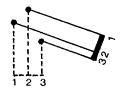
Let me now elucidate the meaning of the foliants with my well-established
diagram:
The intervals are regular. The second note is higher than the first, the third twice
as low as the second. I rotate the diagram by 60 degrees. This radically alters its
appearance:
The rhythmic interval between the first and the second notes is short, the one
between the second and third significantly extended. The pitch-intervals are
different and stand no longer in a 1:2 ratio. Also, the tone-sequence has changed
to appear as: 3, 2, 1. The musical circumstances, intervals, rythm, and sequences
vary according to the degree of rotation. In short, the original diagram contains an
incredible potential for multiplicity and more possibilities than is at first visible.
Art is flexible, if only someone is ready to flex it.
The foliants demonstrate this. They reveal more than can be glimpsed through a
keyhole. Of course we can also look at a landscape through a keyhole – and even
enjoy it. But that is not how we get to know the big wide world. The foliants show
us that ignoring the keyholes pf experience and opening wide the doords instead
will teach us more. It is up to us to comprehend this freedom.
Boguslaw Schaeffer
(translated by Rana Syed/Peter Corser)

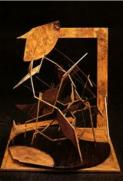
The experience, that the initial impetus to deal with a certain acoustic structure can lie in
visual perception, created the need to seek a notation which would express the mutual
influence an interlocking of these two sensual qualities.
This led to the concept of three-dimensional notation and to the creation of the foliants.
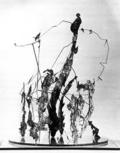
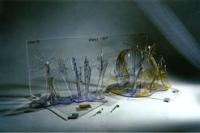
A foliant is a work for chambermusic composed for a certain instrument and – ideally – for a
certain performer. Each foliant is unique; the number is limited to one hundred pieces.
The basic set-up is a disc on which are erected certain constructions in front of a screen
indicating the musical system. The elements of these constructions can be decoded as
notes (variing in duration and pitch), as timbre, articulation and expression. Like the turning
of pages the disc can be rotated to arrive at another position according to the interpretation.
This enables an entirely new view and, correspondingly, a new constellation of the facture
already known.
The final musical version depends on the composer as well as on the performer. The
acoustic result pf a foliant can be seen both in an accurately defined aspect (by the
construction) and in a flexible one (by the choice, combination and duration of each
position).
A foliant is meant to be a synthesis of audible and visible forms and colours. Not to suggest
free improvisation but to allow a craetive handling of this composition in all ist aspects
including three-dimensional ones.
Farah Syed/ Martin Daske [back]


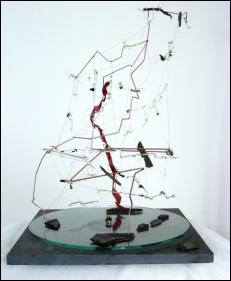
Foliant 30 - für Viola - 2010
Foliant 29 - für Kontrabass - 2009
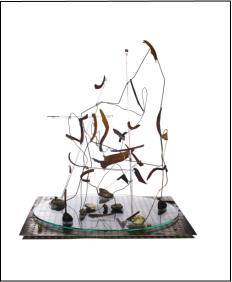
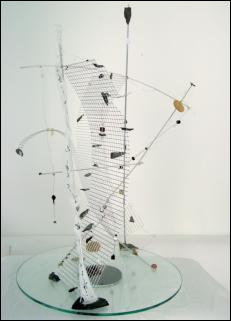
Foliant 31 - für Gitarre - 2010

